Wednesday, October 29, 2008

Horrorfest ’08 Report #3: “You know… for kids!”


It is easy to forget when watching some teenager running through the woods trying to escape death by the most unlikely weapon some psycho killer can get his hands on that our obsession with horror really begins in childhood. Kids are at once scared of everything and fearless. Perhaps our adult obsession with scaring ourselves is somehow a way to reconnect with our youth and tap into that element of fearlessness we may have lost along the way.

There are different kinds of horror for children. The first might be listed in a class syllabus as “An Introduction to Horror”. This course would cover the basics of horror. The jumps and sudden scares, the false frights, and horror appreciation.

First and foremost, it is important for kids to understand that horror is for fun. Pixar Animation Studios has always been excellent at connecting the child and adult worlds with each other. In the 7 minute animated short they included on the “Cars” DVD they’ve submitted their version of An Introduction to Horror titled “Mater and the Ghostlight”. Now, there is nothing really scary about this cartoon—save for maybe the Screaming Banshee, but even that is really a punchline. But it’s a great example of what makes fright fun.

The short involves a prank the car-izens of Radiator Springs play on the rusty tow truck Mater. They all gather around and tell Mater a scary story about the “Ghostlight” and then take off all at once leaving Mater alone to imagine what this ghostlight might do to him in the dark. How many times as a child did you lie awake after some family gathering to ponder the terrible things that might be lurking about while everyone else is asleep, never imagining that anyone else could be suffering the same plight?

They tie a light to Mater’s tow cable and the poor guy drives around frantically trying to escape the ghostlight until he finally realizes it is just a lantern tied to him. Then everyone pops out for a good laugh with (at) their friend. Then comes the punchline, but I’ll leave that for viewers to discover. It is a fun little film that my kids just love, and I think that makes for a great introduction to horror for them.

Later kids get deeper into Horror Appreciation with family movies of the nature Tim Burton likes to make. With movies like “Corpse Bride” and even “Charlie and the Chocolate Factory”, Burton has shown a knack for taking dark themes and making them appealing to kids. Two of his early attempts at kid-friendly horror include his first live-action short “Frankenweenie” and his first stop-motion feature length animation “The Nightmare Before Christmas”.

One thing Burton does with both of these films is saturating them with references to classic horror and science fiction. “Frankenweenie” is a kids version of Mary Shelley’s classic “Frankenstein” story with a little boy bringing his own dog back from the dead. Burton gleefully recreates the reanimation sequence from James Whale’s original “Frankenstein” film—a sequence that is the quintessential mad scientist scene.

Burton is certain not to leave mad scientists and a Frankenstein’s monster type of character out of “The Nightmare Before Christmas” either. The characters of Sally and her creator Dr. Finkelstein add a new twist to the creator/monster relationship from Shelley’s work. In “Nightmare” Sally is the one person in her world who isn’t a nightmare and she seems to be more of an embarrassment to her creator than an abomination. I suppose in Burton’s universe not being a monster is an abomination. But he fills is with catchy songs and bright colors, so the kids still love it.

Eventually, the young ‘uns will crave more than just cutesy horror references, even if there are some dark themes running underneath them. Fantasy films act as a sort of gateway drug from the young viewers. Fantasy carries their hopes and fears and can be the first movies to really provide bumps in the night.

This past year saw the release of two fantasy films—both from popular young readers novel series—“The Seeker: The Dark Is Rising” and “The Spiderwick Chronicles”. Both films are definitely bent toward darker tones and frightening concepts, yet both still hold children as the central heroes. In each film an adolescent is the chosen one to prevent some dark force from taking over the world.
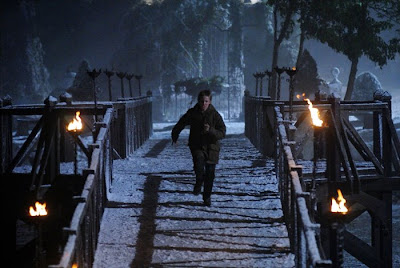
The dark forces in “The Seeker” seem more devious than those in “Spiderwick” but are much less imaginative in conception. While “The Seeker” seems aimed at slightly older children, the fantasy world of “Spiderwick” is much more fun and adventurous. And since “Spiderwick” is more successful at creating an interesting and mysterious world, the small dose of horror in it is more effective.

But effectiveness aside, it is in these fantasy settings where a horror fanatic will find his roots. The notion of worlds that operate under different rules—rules that are more brutal and powerful than those of the world we live in—drives our curiosity. The notion of an unbendable, inexplicable evil that we must inevitably face drives our fears. And when those notions combine, we get a taste for the thrill of horror. The taste is addictive, and we seek out higher dosages and different flavors from that point on.

Tuesday, October 21, 2008

Max Payne / * (PG-13)


Max Payne: Mark Wahlberg
Mona Sax: Mila Kunis
BB Hensley: Beau Bridges
Jim Bravura: Chris ‘Ludacris’ Bridges
Jason Colvin: Chris O’Donnell
Alex Balder: Donal Logue
Jack Lupino: Amaury Nolasco

20th Century Fox presents a film directed by John Moore. Written by Beau Thorne. Based on the video game by Remedy Entertainment and 3-D Realm Entertainment. Running time: 100 min. Rated PG-13 (for violence including intense shooting sequences, drug content, some sexuality and brief strong language).

I’m not a video gamer. I’ve never had the natural ability to just feel a game out, nor can I stand the didactic nature of reading the gamer’s guides that come with the games. There is no reading so dull to me as that in an instruction manual. And gamer’s guides are all written in the same language. L1+∆=jump kick. Uhg!. There is a standard operating language to cinematic storytelling as well. The best films avoid talking in plain language. And then there are films like “Max Payne”, based on the popular video game, that know all the basic symbols but have no understanding of how to properly assemble them.

Max Payne (Mark Wahlberg, “The Happening”) is a New York Detective. Is he a silent brooder who has a reputation for disobeying orders and can’t seem to play within the rules? Is there some tragedy in his past that has made him this way? Is he estranged from his former partner until some small detail draws them onto the same case? Is he implicated in the murder of his partner when their leads start getting them too close to the truth? The answer to all these questions is of course.

Not that this should be the answer. That small detail that leads them back together is that Payne’s wallet is found on the latest victim in a murder pattern that is plaguing the city. Just before his partner Det. Alex Balder’s (Donal Logue, NBC’s “Life”) murder, he realizes that the victim had the same tattoo as one of the murderers of Payne’s wife. Since Payne left the homicide division and took over cold cases because he wanted to devote his work to finding his wife’s killers, and since he had been with the latest victim the evening of her death solely because she wore that tattoo, you’d think he would have already been aware of the connection. But he doesn’t seem to make the connection until after he storms the precinct station house to break into his murdered partner’s office to find out just what Balder had been trying to tell him before he died.

Is it surprising that the victim had an assassin for a sister named Mona Sax? (All right, that name is a bit surprising.) Is it surprising that Mona (Mila Kunis, “That ‘70s Show”) and Payne team up to find out who killed her sister and why? Is it surprising that there is some new designer drug that has become all the rage in the underground yet no one can seem to get their hands on it except for victims of these murders? And with all these comic book superhero movies being made, is it further surprising to learn that this drug was actually the product of some government-sanctioned project to develop some sort of super soldier? Do I really have to answer this?

There is one thing that is not obvious about this plot and that is the visions that are produced by this drug known as Valkyr. There is some sort of malarkey used to explain the super soldier drug, based on Norse mythology that involves the Valkyrie—an angel of death that rewarded soldiers dying on the battlefield. Their images provide some pretty intense trips from this drug and some fascinating visuals for the movie that unfortunately have little to do with the actual plot.

In fact, the visuals are just about the only thing in this movie that has any sort of worthwhile impact. Director John Moore (“Behind Enemy Lines”) is some master of mood. His snowy New York City streets are like something out of Robert Rodriguez’s visually stunning “Sin City”. It’s too bad about his storytelling skills though.

Some other utterly predictable elements of the plot include the fact that Payne is under investigation by internal affairs and IA Detective Jim Bravura (Chris ‘Ludacris’ Bridges, “Crash”) is just about the only person he can trust. I’ll leave it to you to try to guess the role his former superior BB Hensley (Beau Bridges, the “Stargate” series) plays in all this. I would like to submit that Beau should start seeking out little brother Jeff’s advice when choosing scripts in the future. I’ll further add that the stage name of Chris Bridges—no relation to Beau and Jeff—really does a great job of summing up this entire project.


Monday, October 20, 2008

Horrorfest ’08 Report # 2: Our Paradise Lost


Documentaries don’t fit naturally into the tones of Horrorfest. But every once and a while there comes a film or two about real-life atrocities that are undeniable horrors. In the past, Horrorfest has looked at sexual crimes that have been committed under the guise of Godly protection in “Delivers Us from Evil”. I’ve seen the depths to which a sad man will sink just to find acceptance from any group in “Mr. Death: The Rise and Fall of Fred A. Leuchter, Jr.” But perhaps the horrors found in the two “Paradise Lost” films are the most frightening and profound to be found in our world.

In 1993, three children were found brutally murdered in the woods known as Robin Hood Hills in the town of West Memphis, Ark. “Paradise Lost: The Child Murders at Robin Hood Hills” follows the trial of three teenaged boys who were accused and convicted of committing these heinous murders. Without editorializing about whether these kids are guilty or not, filmmakers Joe Berlinger and Bruce Sinofsky present a portrait of a justice system perverted by fear and prejudice. One of the kids has an IQ of 72, while the other two are outsiders who wear black and listen to Metallica; and they are convicted almost solely because of these facts. There is so little evidence against them, it is frightening to think any jury could convict them let alone any judge even allow the case to go to trial.

At one point, a witness is put on the stand who raises a great deal of questions about the case against the boys and presents himself as a strong suspect considering the obvious lies he has told police revealed on the witness stand. But for some reason this doesn’t shake the jury’s preconception that these strange teenagers must be responsible for the murders. The prosecution’s case depends primarily on a fairly obviously coerced confession by the kid with the 72 IQ and the unfounded notion that the murders were some sort of ritualistic witchcraft sacrifice. Nothing is show to establish that either the defendants practice such witchcraft or that the murders were even ritualistic in nature. But this is the primary reason cited for the jury’s guilty verdict.

The second film, “Paradise Lost 2: Revelations”, is even more frightening in the way it reveals details about the murders and the suspects that were overlooked by the trial lawyers and police. Connections are made that could have easily been made at the time of the murders, but nobody seemed to think to ask the questions that led to fairly obvious answers. And the man who so obviously perjured himself on the stand in the trial is revealed to be a charlatan of sorts and possibly guilty of yet another murder. The boys who were convicted have grown into men still bewildered by the fact that such injustice could have been acted upon them, while none of the authorities responsible is even willing to consider the obvious mistakes that were made—even once they are pointed out.

When considering these two films, I am reminded of the course our entire country has taken over the past eight years. It seems most of the major developments in our country during that time have been born out of fear and our attempts to just get past our problems as quickly as possible, without truly contemplating how these problems have developed and what might be the best solutions to them. With our sensation-based media machine, we would rather witchcraft or some other abnormality be the cause of our problems. Something that we don’t really understand is easier to condemn and easier to punish without full justification.

The three kids who were convicted for the murders are still behind bars. One was supposed to have been executed by now, but he is still fighting to overturn his and the other convictions. Berlinger and Sinovsky have been compiling footage for a third film. I’m sure they are hoping some real justice will be served before they finish. Hopefully we can all find some real justice in our world before we are all finished.


Tuesday, October 14, 2008

Quarantine / *** (R)


Angela Vidal: Jennifer Carpenter
Scott Percival: Steve Harris
Jake: Jay Hernandez
George Fletcher: Jonathan Scheach
Danny Wilenski: Columbus Short
James McCready: Andrew Fiscella
Yuri Ivanov: Rade Serbedzija
Lawrence: Greg Germann
Bernard: Bernard White
Sadie: Diana Ramriez

Screen Gems presents a film directed by John Erick Dowdle. Written by John Erick Dowdle and Drew Dowdle. Based on the motion picture “[Rec]” by Jaume Balagueró & Luiso Berdejo & Paco Plaza. Running time: 89 min. Rated R (for bloody violent and disturbing content, terror and language).

It’s one of those human-interest stories. We see a young reporter. Is this one of her first stories? She’s putting together a piece on “a night in the life of an L.A. firehouse.” Her cameraman is filming everything because he’s been told he never gets enough B-roll. She’s awkward on camera at times but charming. The firemen like her for more than just something new in the routine of the firehouse. Everybody is just waiting for that big call.

After a good amount of patience to establish the premise that all of this story will take place from the point of view of the reporter through the lens of her cameraman’s camera, that call comes. One of the firemen informs the reporter that most calls to the fire department are actually medical in nature. They arrive at an apartment building and investigate a woman who has locked herself in her apartment. Once the landlord lets them into the apartment they find she is conscious but unresponsive to their questions. That is until she savagely attacks one of police officers on the scene.

These point of view mockumentary horror films are becoming a bit of a trend these days. January saw the release of the point of view creature feature “Cloverfield”. But unlike “Cloverfield” the action of “Quarantine” is much easier to follow, and the camera work is less jittery. Having a professional cameraman as the character handling the camera work of the story allows for a much more focused and well-framed picture. Also the filmmakers have accounted for the fact that any self-preservationist would stop filming at some point; once power is cut to the building, the camera’s light is about the only source of light left available to the heroes.

While the bouncing camera won’t give as many people motion sickness, the nature of the horror may turn a few more stomachs. The filmmakers have provided a more realistic explanation of what might turn people into vicious flesh-eaters—a notion similar to the one provided in “28 Days Later”. But the CDC is onto the viral outbreak before the people in the apartment building have even realized anything is really wrong, forcing them to try to deal with a savage attack and the fact that they are trapped inside at once. By cutting their characters off from the outside world, the filmmakers create a more claustrophobic experience than the typical zombie movie.

Jennifer Carpenter makes her bid here to be the new scream queen as the reporter Angela. Coming off other horror-related projects like “The Exorcism of Emily Rose” and the television series “Dexter”, Carpenter proves to have likeability similar to that of Jamie Lee Curtis during her reign as scream queen in the early eighties. The establishing scenes at the firehouse allow her to warm the audience. And since she is rarely ever off camera, she shows strength of presence in the way she carries the audience along her terrifying ride.

Director/co-writer John Erick Dowdle and his brother co-writer Drew Dowdle borrowed their story from a Spanish film “[Rec]”. The Brothers Dowdle do a great job structuring their film with little clues as to what is really going on and how it came about, but they keep the focus squarely on the terror of the victims. By placing the audience in the point of view of a participant they increase the audience’s visceral reaction to the material and the whole thing makes for a thrilling and terrifying time. I just hope the CDC got that stuff contained.


Sunday, October 12, 2008

Horrorfest ’08 Report #1: Déjà boo!


Horror is probably the most frequently remade genre in film. Lately, Hollywood has gone through a period of heavy horror remakes. We’ve seen reimaginings of slasher movies (“The Texas Chainsaw Massacre”, “Halloween”), alien invasion flicks (“War of the Worlds”, “The Invasion”), zombie pictures (“Day of the Dead”), creature features (“King Kong”) and Japanese ghosts stories (the list is nearly endless).

One of the reasons horror is so frequently remade for the big screen is that people come for the genre, not the stars. This allows the studios to make horror movies cheaply. If they use a story that has already been tried and successful, that is something else that can entice an audience without much effort put in by the studio to sell it.

Over the past eight years of Horrorfest I have delighted in the privilege and suffered through the pain of a great number of horror remakes and a good deal of their original versions. This year I wanted to make a point of looking at two of 2008’s remakes and their originals back to back. I took a look at two unusual remakes and their original versions. “Prom Night” is unusual because the original is far from a classic. The German movie “Funny Games” is just an unusual one to repackage for American audiences, and the way they went about that was even more unusual.

I suppose it isn’t a stretch to think someone felt “Prom Night” needed to be remade. It is a fairly basic slasher premise, which works as well with modern audiences as it would have 27 years ago. Perhaps they felt they could improve upon it. That wouldn’t have taken much, since the original seemed primarily to be trying to capitalize upon Jamie Lee Curtis’s reign as the original Scream Queen.

Curtis was in the middle of a slew of slasher films at the time “Prom Night” was released, starting with the original “Halloween” and including “The Fog”, “Terror Train” and “Halloween II”. It’s really a toss up as to which is worse, “Prom Night” or “Terror Train”. I’m sure a remake of “Terror Train” is right around the corner.

The original “Prom Night” starts out promisingly with some interesting storytelling techniques. There is this interesting motif established where the audience is allowed inside the thoughts of several of the characters, but as the movie gets into the slasher patterns this motif is dropped. The slasher sequences aren’t the most original or even particularly well done. Plus Leslie Nielson starts as a driving force in the movie and eventually just disappears from the plot. But the movie does a good job of keeping up some of the 70’s cinema horror points that have since become taboo—most notably the idea that evil is born out of children.

The remake, which really had some great potential to improve upon its predecessor, drops all of the positive aspects of the original film and falls into far too many of the pitfalls of modern horror movies. Instead of capitalizing on the cruelty of children, the new “Prom Night” only keeps the prom night part of the premise. In fact everything happens on prom night at a prom that takes place off campus in a luxury hotel, so there aren’t even all those clicks and clashes of high school life for the filmmakers to fall back on. Yes, there is a rivalry going on for prom queen, but without showing these characters interacting within their everyday environment, the filmmakers really miss out on an opportunity to explore any deep hatred shared within high school rivalries.

And instead of linking the killer with these rivalries, we are given a lame set up of a former teacher who stalked one of his students to the point of killing her entire family. Now, she’s going to prom and the killer has escaped. Knowing who the killer is and what his motivations are from the beginning allows much of the tension to escape from the script, which never provides a good reason for him kill anybody. He should have just abducted her. Perhaps the filmmakers should have actually watched the original “Prom Night” and tried to improve upon the themes of that movie, rather than just reading a synopsis from which they only seemed to gather that a bunch of teenagers are stalked by a killer on prom night.

“Funny Games” is another beast altogether. The original 1997 German film depicts a happy family that is visited by two young men at their vacation home and is tortured by the men over the course of one night. The 2008 American remake depicts a happy family that is visited by two young men at their vacation home and is tortured by the men over the course of one night. Now there’s some déjà vu for you.

The new film is a shot for shot, breath for breath, dramatic pause for dramatic pause remake of the original by that film’s same director Michael Haneke in his American debut. How did this happen today? A movie from another culture gets remade in America and it isn’t changed to match America’s taste for prepackaged, homogenized, predictable and pleasing patterns?

And the key to that last question is “pleasing.” This movie will not please audiences in any sense. It is disturbing and brutal. Even though it is a brilliant film—in both versions—few will enjoy it. And perhaps the most disturbing part of the remake is that after ten years, Haneke’s outlook on the world is so bleak he chose not to change a thing.

Watching these two versions—which only differ in their cast, settings and a couple of lines here and there to establish the story as taking place in America or Germany—I was reminded of the only other shot for shot remake I ever seen, Gus Van Sant’s 1998 version of Alfred Hitchcock’s “Psycho”. Both of these remakes, in essence, still contain the same power of their originals, but critics embraced neither. I honestly don’t get it. They were remade with the same mastery of craft of their originals, with minor differences caused by new acting interpretations. The color cinematography did hurt Van Sant’s “Psycho”, but not enough to condemn it. And in “Funny Games” Naomi Watts is far too glamorous to retain the profundity of the crime committed against Susanne Lothar’s mother in the original because desire might play some part in the men’s acts against Watts. So there is reason for some of the greatness of these stories to have fallen away from the remakes, but they do retain most of the same values of their predecessors.

There is great value in remaking genre films. Mostly it allows filmmakers to introduce material to an audience that might otherwise be unaware that it already exists in another form. But a remake requires an even greater responsibility on the filmmakers’ part to present an important commentary on the material presented. This is why so many remakes fail. Producers seem to think a remake requires less responsibility, as if there is less to be created or that the audience will bring more to the movie to begin with because of familiarity with the title. The remake is an important thing indeed, something to be taken just a seriously as any film endeavor.

Wednesday, October 08, 2008

Beverly Hills Chihuahua / *½ (PG)


Rachel: Piper Perabo
Sam: Manolo Cardona
Aunt Viv: Jamie Lee Curtis

And featuring the voice talents of:
Chloe: Drew Barrymore
Papi: George Lopez
Delgado: Andy Garcia
Manuel: Cheech Marin
Chico: Paul Rodriguez
Monte: Plácido Domingo
Diablo: Edward James Olmos

Walt Disney Pictures presents a film directed by Raja Gosnell. Written by Analisa LaBianco and Jeff Bushell. Running time: 91 min. Rated PG (for some mild thematic elements).

I considered writing just a couple-word critique for this movie. Something like, “Ay caramba!” I also considered writing an entire full-length review using just the word “bark!” as if I were using dog language. But despite my poor opinion of the movie, I felt these approaches were cop-outs. If this movie doesn’t deserve much serious consideration for all audiences, it is at least trying to provide an entertaining experience for kids.

“Beverly Hills Chihuahua” is not a good movie. It might have enough to it to satisfy younger viewers but leaves their adult chaperones a little bored and grasping to get their heads around the preposterousness of a cast of live-action talking animals. This is certainly not the first time we’ve seen animals talking in a live-action movie, and a very few of them actually pull off the concept (“Babe”), but Hollywood’s fascination with personified animals is generally something only for the young in mind.

The surprising thing about “Beverly Hills Chihuahua” is the complexity of the story. The premise is basic—a rich California Chihuahua finds herself lost in the grimy land of Mexico and must rely on dogs and other animals she once looked down upon to get her home. But there are a surprising number of characters and events that inhabit this premise, especially considering its short running time.

We are introduced to Chloe, the title canine voiced by Drew Barrymore (“Curious George”), living in the lap of luxury and being pampered beyond all reason by her owner Aunt Viv (Jamie Lee Curtis, “Freaky Friday”). Viv is the aunt of Rachel (Piper Perabo, “Cheaper by the Dozen”), with whom she entrusts the care of Chloe when she goes to Europe on business. It is no surprise that Chloe becomes lost in Mexico while under Rachel’s care. Nor is it a surprise that Rachel must enlist the help of Viv’s landscaper Sam (Manolo Cardona) and his Chihuahua Papi—who incidentally has a crush on Chloe and is voiced by George Lopez (“Swing Vote”). It should be said these human characters are merely perfunctory and therefore a waste for such talents as Perabo and Curtis.

The first place Chloe winds up in her misadventure is in the seedy underworld of dog fighting, where she must face the Doberman Diablo (voiced by Edward James Olmos, Sci-Fi Channel’s “Battlestar Galactica”). Because everyone wants to see a Doberman eat a Chihuahua, and so many people are going to bet on that fight. Someone may have gotten a hold of the script and beaten some astounding odds, huh?

Chloe is saved by a good-natured German Shepherd named Delgado (Andy Garcia, “Oceans Thirteen”). Delgado is reluctant to help the prissy little dog, but his better nature wins him over, and both dogs learn they aren’t so different from each other, and blah, blah, blah. There are some other characters thrown into the mix, like the rat and chameleon, voiced by Cheech Marin (“Planet Terror”) and Paul Rodriguez (“A Cinderella Story”) respectively, who take advantage of the lost pup at first and later help her because their worlds aren’t as far apart as they might seem, and blah, blah, blah.

Yeah, this is a basic story at best, but it doesn’t take the usual lost dog road movie lines where the animal characters who help the heroine come in, do their thing, and then disappear from the scene. The animals here are surprisingly involved in the screenplay, with running subplots about each of them. Most of the characters are still involved at the story’s climax. Unfortunately, the original approach doesn’t provide any original material.

The animators at Pixar have proven time and again it’s quite possible to create family entertainment that can appeal to a broad audience despite age. The big problem with “Beverly Hills Chihuahua” is that it is content to be simply what it is—a movie where dogs and other animals talk. I didn’t laugh once during this movie because director Raja Gosnell (“Scooby-Doo”) and his screenwriters seem to think the gimmick of talking animals is enough to be entertaining all on its own. Perhaps for a six-year-old it is; but for my money, watching my Corgi go at one her toys at home is more fulfilling.


Saturday, September 27, 2008

Eagle Eye / ** (PG-13)


Jerry Shaw: Shia LaBeouf
Rachel Holloman: Michelle Monaghan
Zoe Perez: Rosario Dawson
Agent Tom Morgan: Billy Bob Thornton
Defense Secretary Callister: Michael Chiklis
Major William Bowman: Anthony Mackie

DreamWorks SKG presents a film directed by D.J. Caruso. Written by John Glenn & Travis Adam Wright and Hillary Seitz and Dan McDermott. Running time: 118 min. Rated PG-13 (for intense sequences of action and violence, and for language).

“If a butterfly flaps its wings in China, will it rain in London?”

There are as many variations on this saying—known as “the butterfly effect”—as the infinite possibilities that the Chaos Theory behind it suggests. But chaos does not apply to the modern action thriller. The plots are too structured and intricate to allow for variants of any kind. Even when a plot seems to allow freedom of choice for its characters, that freedom is usually an illusion of the plot that is either well hidden or not. “Eagle Eye” is one of those movies with a plot so preposterous that even the slightest notion of random elements have been vanquished from the script.

Chaos works against a movie like this. Like in a scene where the movie’s hero is in a car that has been picked up by a giant crane, and the villain’s plan depends upon the hero jumping out of the car at a specific point. Before the action reaches that point the car’s front window must fall out so the hero can jump through it. In order to achieve this the villain allows the crane to tip the vehicle forward, but how does the villain know the hero will maintain his grip on the car’s dashboard long enough to make it to the point where he must jump from the vehicle? The villain eventually explains some computer program that allows for the perfect personality test, which tells exactly how a person can be manipulated, but no personality test could determine whether someone will loose his grip for a million other unpredictable reasons.

But I’ve gotten ahead of myself. The hero is Jerry Shaw, a loser who has dropped out of Stanford, can’t keep a steady relationship, works at the Copy Cabana, and can’t even pay rent on his dump of an apartment. There is one thing special about Jerry. His is a twin. His brother excelled at everything he did. He was living a successful career with the Air Force, when he was killed in a car accident.

When Jerry returns from his brother’s funeral, he finds things have changed in his life. His bank account now has $750,000 in it, and his apartment is filled with state of the art military weapons and deadly chemicals. He receives a phone call in which he is told the FBI will be there in 30 seconds and that he must get out of the apartment. He doesn’t. But after a cool-tempered anti-terrorism agent played by Billy Bob Thornton tells Jerry he’s in “a lot of trouble,” Jerry is forced to escape and follow the instructions of the mysterious voice that is able to call him on any phone and is aware of his every movement.

Jerry is not the only innocent pulled into this sinister mystery plot. Rachel Holloman is a single mother forced into the plot for fear of her son’s life, although it seems the villain’s scheme would have been more efficient by only involving her son and leaving her out of it. But then Jerry wouldn’t have anyone to work off.

Shia LaBeouf (“Indiana Jones and the Kingdom of the Crystal Skull”) continues to prove he is a compelling actor to watch on screen with his ability to make Jerry a believable hero. And Michelle Monaghan (“Mission Impossible III”) is appropriately desperate to save her son as Rachel. But neither actor seems to grasp the absurdity of their characters’ use in the plot. For a movie that is all situation, these two actually seem to think this is all about them.

Thornton is as smooth as ever as Agent Morgan, although he conveniently buys into the alternate theory he has fought against for the entire film at just the point he must. That theory that Jerry and Rachel are being manipulated is presented by an Air Force investigator played by Rosario Dawson (“Clerks II”). Although it is nice to see Dawson get a shot at a high profile role, she isn’t given much to do beyond figure out what is really happening pretty much by accident. Michael Chiklis (FX’s “The Shield”) is given a good opening scene as the Secretary of Defense, but is quickly lost in the movie’s design.

Director D.J. Caruso teams up with LaBeouf a second time, their first collaboration being the Hitchcockian movie “Disturbia”. And although he has once again cast LaBeouf as another Hitchcockian hero—the falsely accused man—the direction is not handled with the perfection of style as a Hitchcock. The fast-paced quick cuts of many of the action sequences are confusing; especially when so many of the vehicles look alike. And he has a tendency to move his camera without purpose.

I suppose if you can overlook the chaos theory that acts against the intricately detailed plot developed by the villain, this may be an effective thriller for you. But there are just too many things this plot depends on going perfectly in order for it to play out. And the only time things don’t work the way they are supposed to for the villain are when the script requires the characters to break away from the restrictions placed on them. “Eagle Eye” could use just a little more chance in its stratagem.


Friday, September 26, 2008

Horrorfest 2008 Preview: Horror on the Brain!


I walked outside a couple of nights ago and—thanks to an unusually mild temperature year here in Missourah—the smell of fall was in the air. Summer had given way already to the refreshing breeze of a new season—a season where the old begins to make way for the new. And as I breathed in that slightly tangy scent of fall, I knew the bloodbaths of Horrorfest were just around the corner; and that glazed-over look of suffering that the summer heat brings gave way to the glint of a bedeviled perversity that compels so many to sit in a dark room and scare themselves silly.

Although, the smell of fall gave me this thrill of anticipation I feel every year as I stock my Netflix queue full of gore and grisly screams, it all nearly snuck up on me this year. I’ve been busier than ever with my writing and reviews, plus my house is under major construction and my three-year-old is at that age where every hour he is awake requires strict attention to keep him in line. Talk about terror!

October is my favorite month of movie watching all year because of this little obsession I’ve created and dubbed Horrorfest. Unlike most film festivals, this one consists for the most part of one audience member—myself. But I invite all of you readers to join in viewing the films I watch every year during my own personal film festival. So get your rental queues ready!

This year I’m presenting my most structured playlist in the eight years that I have held Horrorfest. The biggest area of focus during this year’s fright fest will be in the area of horror remakes. I plan to watch a couple of originals and their modern remakes throughout the month, including the recent reinterpretations of “Prom Night” and “Funny Games” and their better received original versions. I will also view the recent US remakes of J-horror hits “Mirrors”, “One Missed Call”, and “The Eye”. And I will watch the 1951 original “The Day the Earth Stood Still” in preparation for the December release of the remake starring Keanu Reeves.

I’m also going slightly sequel crazy this year in a study of the recent trend in the “torture porn” subgenre of horror. I’ll be catching up on the “Saw” series by taking in episodes II-IV and hopefully the theatrical release of “Saw V”. I’ll also finally sit down and watch Eli Roth’s popular “Hostel” and “Hostel II”. And I’ll watch perhaps the ultimate torture porn, the highly controversial and critically derided “Chaos”. In the sequel set I will include two documentaries “Paradise Lost: The Child Murders at Robin Hood Hills” and it’s follow up “Paradise Lost 2: Revelations”.

Of course there will be the standards subgenres of zombies (“Let Sleeping Corpses Lie”, “Undead”, “Diary of the Dead”, “The Signal”, “American Zombie”) and vampires (“Skinwalkers”, “30 Days of Night”, “The Fearless Vampire Killers”). My look into the vampire subgenre will also include an overview of the first few episodes of HBO’s new series “True Blood”. There will also be a couple of scares aimed at kids, including “The Spiderwick Chronicles”, “Igor”, and Tim Burton’s cult-turned-popular hit “The Nightmare Before Christmas”.

I’ll also try to find some hidden gems in movies that may have been overlooked like “Awake”, “The Orphanage”, “Prey”, “Scarecrows”, “P2”, “Stuck”, and the HBO mini-series from last fall “Five Days”. As usual there will be a couple of goofs like 1976’s rats-attack picture “The Food of the Gods” and Uwe Boll’s latest anti-masterpiece “Postal”. And I’ll try to figure out what happened to M. Night Shyamalan’s “The Happening”. And I’ll watch an old acquaintance’s first feature film, Carter Smith’s “The Ruins”.

As usual this list is not set in stone. There will be titles I won’t get to, and some theatrical releases that I haven’t listed might drift into town. I’d really like to get a peek at “Quarantine”. One of the pleasures of Horrorfest is that I might just happen along something on cable or even in my own library, and discover a movie I hadn’t planned on watching, but was so glad I did.

One such movie that was not intended to be part of my Horrorfest lineup, but served as a wonderful appetizer because of its creepiness and ghost-themed story was Guy Maddin’s tribute to silent film “Brand Upon the Brain!”.

Actually, every movie I’ve ever seen of Maddin’s is a tribute to silent film. Last year I watched his “Dracula: Pages from a Virgin’s Diary” for Horrorfest and it was one of the best Dracula movies I’ve ever seen. It was essentially a filmed ballet of the classic Bram Stoker story, and Maddin’s silent film-inspired directorial style was perfect for it.

“Brand Upon the Brain!” however, is the best Maddin effort I’ve seen. It is a ghost story about a man named Guy Maddin, of all names, who returns to his boyhood home. Located on a secluded island where his parents once ran an orphanage, Guy relives the traumas of his childhood in flashback, all narrated by Isabella Rossellini. Young Guy lives under the close protection of his mother who oversees all from her lighthouse telescope, but begins to feel the oppression of her control over him when a famous child detective arrives at the island to investigate the strange behavior of Guy’s parents. Of particular interest to the detective is Guy’s sister who show signs of experiments run on her by her father, signs that all the orphans share.

If the plot sounds strange, the film is even stranger but so well suited to the silent format. It is not truly a silent film because of Rossellini’s narration, however it has been presented theatrically by Maddin with live narration and score. All of the other film techniques are right out of the silent era, and they reveal what great qualities the silent era held for film, especially those of a creepier nature. The whole thing has an otherworldly feel to it that compliments the supernatural nature of its subject matter.


Tuesday, September 16, 2008

He Said, She Said: The Women (PG-13)


One Movie, Two Views

Mary Haines: Meg Ryan
Sylvia Fowler: Annette Bening
Edie Cohen: Debra Messing
Alex Fisher: Jada Pinkett Smith
Crystal Allen: Eva Mendes
Molly Haines: India Ennenga
Maggie: Cloris Leachman
Uta: Tilly Scott Pedersen
Catherine Frazier: Candice Bergen
Tanya: Debi Mazar
Bailey Smith: Carrie Fisher
Leah Miller: Bette Midler

Picturehouse presents a film written for the screen and directed by Diane Eng
lish. Based on the play by Clare Boothe Luce and the 1939 screenplay by Anita Loos and Jane Murfin. Running time: 114 min. Rated PG-13 (for sex-related material, language, some drug use and brief smoking).

“A woman is like a tea bag, you cannot tell how strong she is until you put her in hot water.”
—Nancy Reagan

Synopsis: A loose remake of the Clare Boothe Luce play and the 1939 movie of the same name, “The Women” focuses primarily on two women. Meg Ryan (“In the Land of Women”) is Mary Haines, a fashion designer who has never taken her own risks. The world she inhabits is disrupted when she discovers her husband is having an affair with a younger, sexier “spritzer girl” (Eva Mendes, “We Own the Night”). Annette Bening (“Running with Scissors”) is Sylvia Fowler, Mary’s best friend and a fashion magazine editor struggling to retain her journalistic integrity in a time when gossip has become more important than information. Two other friends support them—Alex (Jada Pinkett Smith, “Reign Over Me”), a lesbian author, and Edie (Debra Messing, NBC’s “Will & Grace”), a mother of four who refuses to stop having children until she births a boy.

He Said / ***
By Andrew D. Wells

What a surprising delight “The Women” is. I went into it expecting a closed-off female cavalcade of clichéd events, forced drama and inside humor; and discovered a free-spirited but serious look into the lives of successful women and the challenges they face in dealing with modern relationships and love. Instead of generalizing the relationships of the women depicted, writer and first-time director Diane English (an Emmy winning writer for television’s “Murphy Brown”) develops very specific characters and situations, without cutting corners on the way these women deal with problems and face challenges.

The plot doesn’t develop along predictable lines, nor does the comedy stoop to cheap slapstick. The humor is intelligent and informs the characters’ strengths and weaknesses. There is an early confrontation between Mary and Crystal, the spritzer girl, which takes place in a lingerie shop. Instead of developing into a catfight between the two women, the scene is handled with a reasonable conversation that springs out of the characters’ feelings about the situation. The dialogue is funny and smart, and reveals important details about whom these women are rather than pandering for cheap laughs.

Mary’s relationship with her daughter Molly (India Ennenga, the voice of children’s character “Pinky Dinky Doo”), and the unexpected relationship that develops between Molly and Sylvia are also handled with keen observation of the inexperience teenagers have in dealing with adult issues. At first, it seems as if Molly is going to be just an accessory character—someone to shake her head at the adult behavior—but she turns out to be a real teenager who is greatly affected by her situation and needs an adult to help her through it. And I appreciated that English didn’t make all the women’s attitudes toward children the same. It is rare to see women that are allowed to dislike children without being the villain.

But all that I’ve said here might give the impression that this movie is some sort of realistic drama where the audience is shown the hard realities of life. Nothing could be further from the truth. “The Women” is a fantasy of sorts. There are no men to be seen in the entire film, save one. (Can you spot him?) All of these women are successful, living a New York high life where money is only a logistic issue and the characters’ problems are fairly cosmetic. But this good life does not work against the movie’s success. The filmmakers have depicted these women’s charmed lives in order to draw the audience into a world we want to enjoy.

“The Women” also gives the impression of a road movie in the way English populates the film with many characters who drift into the story to offer insight and advice to our heroines and then drift out again. There are important cameos by Candice Bergen, Cloris Leachman, Carrie Fisher, Bette Midler, and Debi Mazar. Each of these performers brings their own personal signature to the insight their characters provide. And the characters of Edie and Alex help to balance out the heavier parts of the plot with some good old-fashioned comic relief in the final scenes.

At a time when too many comedies take the easy way to the laugh by having their characters behave like children, it is nice to see a movie that has the integrity to show adults deal with their problems by trying to resist childish impulses. The characters in “The Women” actually consider their situations before acting upon them—some longer than they should. And they pay the consequences for their actions, but they also live with verve and purpose. “The Women” isn’t content to merely make fun of life’s difficulties; it works through those difficulties with humor.

She Said / ***
By Angie Wells

First, I’ll say, I asked my husband to get this movie for me for Christmas. I loved it. I gained inspiration from it. And it made me realize how lucky I am to have a good husband and good friends. Born and raised in small town America—rather than the bustling streets of Manhattan—I find I am lucky enough to have the same four best friends now as I did in elementary school. We are miles apart now but still keep in touch and visit often. After seeing “The Women”, I realize how much I value my friends and how much I miss being close to them.

“The Women” is a wonderful film about friendship and life. Yes, we’ve seen that set-up a hundred times, but this one is different. Having money doesn’t make one immune to the heartaches that life sometimes throws at us. Four friends’ relationships are tested and tried when they discover one has a cheating husband. One lives the life of the perfect socialite mother. One has broken through the glass ceiling. One believes her duty is to procreate. And one’s a lesbian who has trouble rising before noon.

The director’s choice to have only one male character appear in this film is amusing. I spent most of the film waiting and wondering which man we might see. The cheating husband maybe? Or someone more insignificant, like a handsome cabana boy or shirtless gardener? I won’t give it away, but it was worth the wait! This restriction does present a few hurdles for the director. Some scenes would’ve been better with a man written into the script, but I can only think of one scene in which the concept felt forced. Overall, I enjoyed the novelty of it.

The A-list cast is a joy. One of my favorite actresses, Meg Ryan, plays the slighted Mary Haines. (Meg, the one we love to hate. Is anyone really that cute?!? Honestly?) Mary finds herself betrayed—a situation all women fear. And not just by her husband, but by her best friend, too. Like many women, Mary has put her own life aside to raise and care for others—her husband, her daughter, and her community. One day she wakes up to find the rug has been pulled out from under her.

Her best friend Sylvie serves as the rock in this group of four friends. She is successful, outspoken and dynamic; but still has trouble finding the backbone to tell her best friend her husband’s cheating on her. Edie is a brilliant mess of a mother, a pregnant goody-two-shoes with a skeleton or two in her own closet. And Alex is the lackadaisical author, whose sexual preference in women provides comic relief from the very serious situations. It was great to see Alex and Edie come alive in the last scenes. Jada Pinkett Smith and Debra Messing steal the show in the last minutes of the film. Eve Mendes, as Crystal Allen, represents what most middle age women fear most—a young hottie with little respect for other women.

I found several similarities to my friends and me in this film. Each character has a trait similar to that of a friend of mine, making it easy for me to understand their relationships and judge their reactions to certain situations. But there were some flaws in this film. Other than her husband’s infidelity, Mary has a very cozy life. She is wealthy, has a daughter and good friends, and is very involved in bettering her community. Her life isn’t all that terrible. I found there were some issues that were difficult to relate to. Because of their privileged lifestyles, some problems were met with unrealistic answers for most of us. For example, Mary decides what she really wants out of life and the money to finance her lifelong dream materializes out of thin air. Most women wouldn’t be able to produce the start up cost on a venture like that! Then there’s the three months she “takes off” from real life to soak in her sorrow, but still manages to afford that million-dollar home in Connecticut with the housekeeper and nanny.

This film did a great job of showing how complex and meaningful female relationships can be. Life is messy. We all make mistakes, men and women alike. Some can be forgiven, others cannot. I loved that this film allowed the characters to make realistic choices, and didn’t stick to the cookie-cutter mold often found in Hollywood female entitlement movies. This film is great for women and men who value friendship. We all should treat our friends with the highest respect and gratitude. We never know when we might need them.

But that’s just a girl’s opinion!


Sunday, September 14, 2008

Mirrors / *½ (R)


Ben Carson: Kiefer Sutherland
Amy Carson: Paula Patton
Michael Carson: Cameron Boyce
Daisy Carson: Erica Gluck
Angela Carson: Amy Smart

20th Century Fox presents a film directed by Alexandre Aja. Written by Aja and Gregory Levassuer. Based on the Korean motion picture “Into the Mirror”, screenplay by Sung-ho Kim. Running time: 110 min. Rated R (for strong violence, disturbing images, language and brief nudity).

There is a word that should never be associated with something that is supposed to surprise and even scare its audience. That word is ‘routine.’ For the past decade Hollywood has endeavored to adapt horror films originally made in Asian markets, like Korea and Japan. Most of these movies—often referred to as J-horror—are ghosts stories. In their original versions, they tend to be creepy atmospheric portrayals of ghosts trying to communicate some important past mistreatment to the living. Interestingly enough, the stories depend on the ghosts interrupting the routines of the living and jolting them out of their ignorance of the world’s atrocities. These movies are original and unique in the way they perceive horror in our modern world. In the American versions, their structure and execution are too often the routine aspects about them.

In “Mirrors”—a remake of a Korean movie—Kiefer Sutherland (FOX’s “24”) plays Ben Carson, a former New York City police detective who shot a uniformed police officer while working a case under cover. The details of the shooting remain a mystery but are frequently referred to by other characters with typical comments, like “I stood behind you,” “Nobody doubts you,” and “You’ll get through this.” Yet the filmmakers seem to want the audience to think that nobody believes him in whatever it was he claimed happened.

Ben has gone through all the typical dejection of a fallen hero. At the start of the story it has already been a year since his suspension from the force. He has separated from his wife and family. He has been through the throes of alcoholism and been sober for the past three months. And he’s living on the couch at his sister’s (Amy Smart, “Crank”) apartment.

There is an early expositional scene with his wife Amy (Paula Patton, “Déjà vu”) that works as a great example of the screenplay’s laziness. The couple has a fight about Ben’s behavior since his suspension where no details are discussed, just general attitude. The scene ends with no clear reason for their separation given and Amy screaming at him about how well she supported him.

For all of the lack of detail in the dialog by Gregory Levassuer (“P2”) and co-writer/director Alexandre Aja, the graphic nature of the film’s first scene betrays its own horror value with too much detail. The scene depicts a man slitting his own throat in front of a mirror. His image in the mirror performs the murder while the real man suffers the effects. Aja makes the mistake of showing too much graphic detail of the man’s throat opening up. While the thought of a man slitting his throat will make you squeamish, the sight of it—with its innards and excessive blood—is too unreal and loses its power. Aja had great success in not showing audiences the whole story until the end of his French-made breakthough “High Tension”, but when he remade the Wes Craven classic “The Hills Have Eyes” he proved his inclination for showing the audience too much of the gore to retain the tension of the horror.

Not surprisingly, no one believes Ben when he claims that the mirrors in the burned-out department store where he takes a night watchman job are trying to communicate with him. He decides to look into the history of the building and discovers a secret that could have been told to him by anyone who had ever seen a ghost movie in the past ten years. After a tragedy befalls someone close to him, he discovers that the ghost can find him or his family members through any mirror. Unfortunately, this incident is not exploited by the plot to make Ben’s search for the truth more difficult. It should seem that he is the culprit, but this avenue is never explored.

What strikes me the most about the Hollywood take on these ghost stories is that the ghosts are so insistent on haunting the least credible source they can find. Sutherland’s cop is such a shattered and broken soul himself, why would the ghost feel that he was the answer to its mystery, the solution to its truth. There is a least one other candidate for the ghost to pick on, but the ghost chooses this ex-cop who is possibly guilty of some former crime. Do these ghosts reach out for a broken spirit because it is closer to them? And why do they make the task they have for their victim to perform almost impossible to achieve? Certainly it must be difficult to communicate from the grave, but why make it harder for the living to solve their mystery by destroying his life?

Of course, these are merely general problems I have with this subgenre of horror, but “Mirrors” has some very specific missed opportunities. One involves a nun who provides one of the more intriguing possibilities about what might happen if the ghost gets what it wants, but the theological implications of her concerns are not explored in the film’s climax; instead Ben must engage in an unlikely physical battle with the ghost that ends without any explanation of how the ghost could truly be stopped. And the final scene of the film would have been a welcome exploration of the movie’s theories about the magic behind mirrors had it occurred earlier.

It seems like Hollywood is so eager to embrace the plots of these J-horror movies without ever trying to understand why they are effective. The originals are rarely just moody frightfests—although they do usually contain frightening moments and images—but they tend to explore the lives of the people who find themselves victims of these hauntings. It’s as if the filmmakers are hesitant to explore the true nature of these movies but are content to stick to a routine that eschews their power.


Monday, September 08, 2008

Journey to the Center of the Earth / ** (PG)


Prof. Trevor Anderson: Brendan Fraser
Sean Anderson: Josh Hutcherson
Hannah Ásgiersson: Anita Briem

New Line Cinema and Walden Media present a film directed by Eric Brevig. Written by Michael Weiss and Jennifer Flackett & Mark Levin. Based on the novel by Jules Verne. Running time: 92 min. Rated PG (for intense adventure action and some scary moments).

“If at first you don’t succeed, try, try again.”
— Thomas H. Palmer, “Teacher’s Manual” (1840)

There are certain properties that seem to get made into movies over and over again. It happens a lot with science fiction literature adaptations. Jules Verne’s “Journey to the Center of the Earth” is a story that has particularly dogged filmmakers—especially of late. Perhaps the best known movie version is the earliest attempt at the material, the 1959 film starring James Mason and Pat Boone; but IMdb lists no less than 12 other versions of the property since then, including 5 television adaptations in the last 15 years.

The makers of the latest theatrical version of “Journey to the Center of the Earth” have tried to take advantage of the technological advances in film medium to give us an experience unlike any of the previous versions. “JCE” holds the distinction of being the first live action movie to be presented in the new digital 3D format. Of course, the makers have also taken advantage of the most recent CGI technology to create digitally animated scenery and creatures for the story; so much of the movie isn’t truly live action.

Unfortunately, Marshall Cinemas haven’t been equipped with the expensive digital 3D projectors; so I’m not able to comment on the effectiveness of the new format in respect to this movie. In a way, that allows for an impartial analysis of the movie itself, which should be able to stand on its own without the gimmick of three-dimensions.

To go along with the new technology, however, the filmmakers have taken a new approach to the material of Verne’s classic science fiction adventure novel. Instead of just adapting the story Verne wrote about a scientist who discovers volcanic tubes that lead to a world contained within the Earth, screenwriters Michael Weiss (with his first theatrical writing credit), Jennifer Flackett and Mark Levin (the writing team behind “Nim’s Island”) suppose that Verne’s novel was not fiction at all but a first person account told to Verne by the very scientist he uses as his hero.

In the present day, Brendan Fraser (“The Mummy: Tomb of the Dragon Emperor”) is Professor Trevor Anderson—a seismic expert continuing the work of his brother, who disappeared more than ten years prior. Through some fairly routine scenes depicting his classroom etiquette and a disheveled apartment, we find that Trevor is not a very organized person. That is why it has slipped his mind that he had scheduled a 10 day visit with his brother’s teenaged son, Sean (Josh Hutcherson, “Firehouse Dog”). How inconvenient for him that on the very day Sean arrives the seismic sensors he and his brother had placed in strategic positions around the world show their first signs of activity since the brother’s disappearance.

The numbers point toward a seismic event in Iceland—the very location where Verne’s adventure begins. Trevor goes to investigate with Sean in tow. Once in Iceland, they hire a guide, Hannah Ásgiersson (Anita Briem, Showtime’s “The Tudors”). The three find themselves trapped in the volcano where Trevor’s readings were emitting and end up discovering the very tubes Verne described in his book. Soon they are retracing the steps of Verne’s scientists and ducking all the same dangers encountered in the book.

What is interesting about “JCE” is that it actually takes the time necessary to set up its intricate premise. Considering the 3D gimmick and the trends of modern Hollywood filmmaking, one would expect director Eric Brevig (a visual effects supervisor for such blockbusters as “Pearl Harbor” and “The Day After Tomorrow”) to be chomping at the bit to get to those action sequences. This cinematic patience might make younger viewers a little restless, but it allows the filmmakers to preserve the themes and scientific logic of Verne’s novel.

The action does eventually start rolling, but it is here where the movie strikes its warbling notes. Unlike the stunning visual effects Brevig was responsible for in the underrated 2003 live action “Peter Pan”, the world created for the center of the Earth never feels real. The actors seem to hover just above the ground in their CGI locations. And there is an overall impression that the budget was just a little too small to afford the shots Brevig really wanted. Plus throughout the movie—including the real location scenes—Brevig goes out of his way to exploit the 3D format, resulting in cheap 3D thrill shots, like when Fraser spits out his toothpaste right into the camera, or the coal mine car rollercoaster scene, which was done better more than 20 years ago in “Indiana Jones and the Temple of Doom”.

Verne’s story of a world within our world seems like it would be a natural candidate for cinematic adaptation. It’s an adventure that relies more on thrills than substance and offers a glorious fantasy world for audiences to behold. For some reason, however, filmmakers just can’t seem to make it work. In this day and age of realistic CGI animation and digital 3D formats, it would seem as if the time is ripe for a good version of this sci-fi classic. But for now, it’s back to the drawing board.